A proven, practical SaaS guide for 2025: costs, security, AI trends, and smart selection steps so your business scales faster with confidence.
Introduction: SaaS is no longer optional in 2025
In December 2025, SaaS is a critical business default. It is fast. It is flexible. It is often the simplest path to modern operations.
Yet SaaS can also feel overwhelming. Choices are endless. Promises sound revolutionary. Contracts can hide painful traps.
This guide cuts through the noise. It explains SaaS in clear terms. It shows what to buy, what to question, and what to measure.
You will learn how SaaS works. You will see the real benefits and the real risks. You will also get a proven evaluation method that busy teams can use right away.
Most importantly, you will leave with a confident plan. It will feel practical. It will feel safe. It will feel rewarding.
SaaS basics: the clear picture every leader needs
To make smart decisions, you need a shared definition. That clarity is powerful. It also prevents costly misunderstandings.
What SaaS is, in simple business terms
SaaS means you use software over the internet. The vendor hosts it. The vendor maintains it. You pay a recurring fee.
Access is usually via a browser or an app. Updates arrive often. Support and fixes happen on the vendor’s side.
This model is convenient. It can also be a breakthrough for small teams. You get enterprise-grade tools without enterprise-grade setup.
What SaaS is not
SaaS is not “any cloud.” It is also not the same as “custom software.”
You do not control the full environment. You do not fully control the update schedule. You also do not own the platform code.
That tradeoff can be fantastic. Still, it demands smart governance.
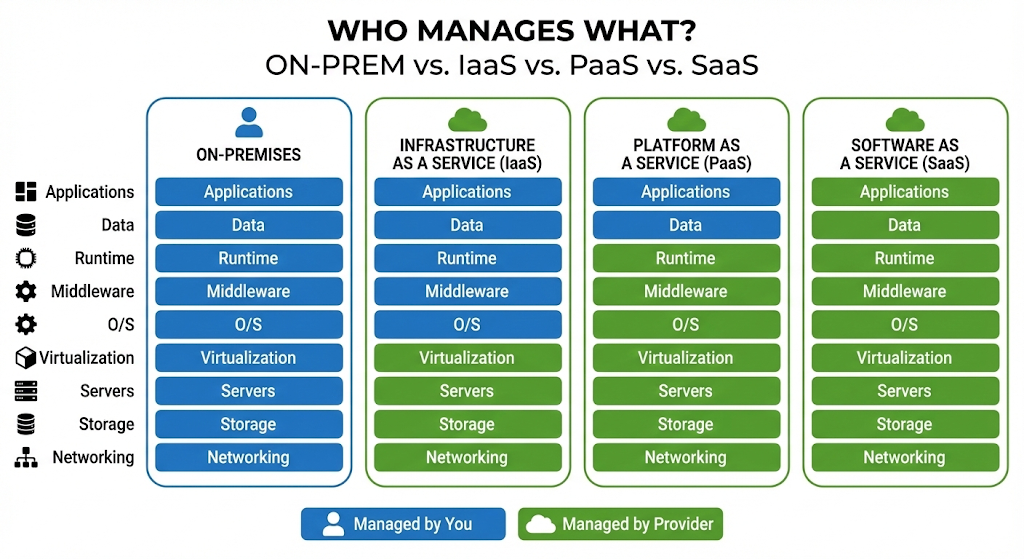
SaaS vs on-prem vs PaaS and IaaS
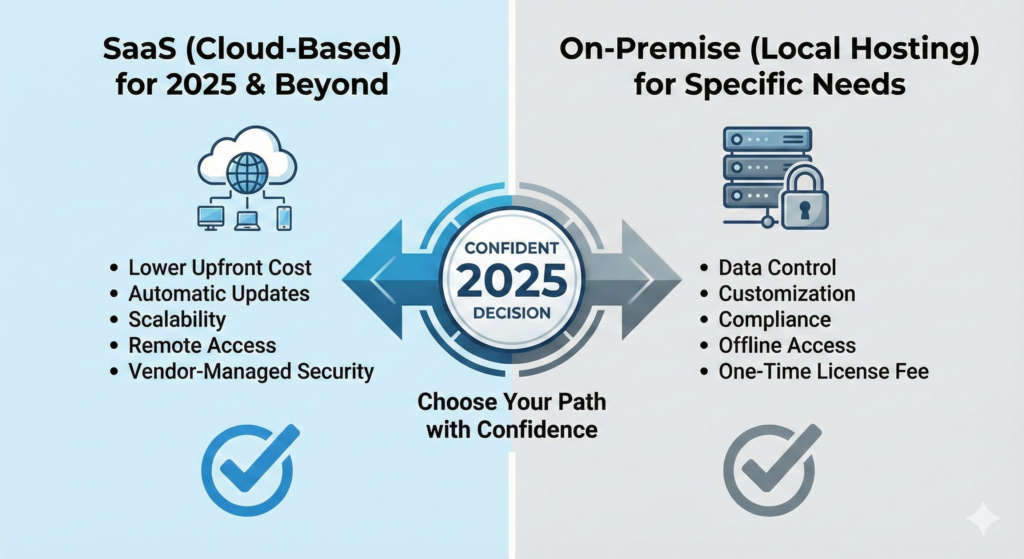
On-prem software runs in your own servers. You manage hardware. You manage patches. You carry more risk and more control.
IaaS gives you raw infrastructure. Think virtual machines, storage, and networks. You still manage many layers.
PaaS gives you a managed platform to build apps. It reduces ops work. It still requires engineering effort.
SaaS gives you the finished application. It is the fastest path to business value.
Why SaaS is essential in 2025
Now, let’s connect SaaS to the 2025 reality. The pressure is real. The upside is also huge.
Cloud spending keeps rising, and SaaS rides that wave
Public cloud use is still expanding fast. Gartner forecast worldwide public cloud end-user spending at $595.7B in 2024 and $723.4B in 2025. (Gartner)
That growth is not just hype. It reflects real migration. It reflects real business demand.
IDC also forecast worldwide spending on public cloud services to reach $805B in 2024, with expectations it will double by 2028. (IDC)
Consequently, SaaS becomes the default buying path. It is the easiest consumption model for many teams.
AI copilots changed what “modern software” means
Generative AI is now embedded into many SaaS tools. This shift is exciting. It is also urgent.
Microsoft’s Work Trend Index reported 75% of global knowledge workers were using generative AI at work in 2024. It also found 78% of AI users bring their own tools to work. (Source)
That reality creates a critical leadership moment. You can ignore it and risk chaos. Or you can guide it and gain a verified advantage.
Hybrid work and distributed teams are normal
Additionally, SaaS supports modern work habits. People expect access from anywhere. They expect fast onboarding. They expect smooth collaboration.
When SaaS is chosen well, it feels effortless. When it is chosen poorly, it feels frustrating.
The real benefits of SaaS that executives care about
SaaS marketing loves big claims. Let’s ground the benefits in outcomes that matter.
Faster deployment and faster wins
First, SaaS can deliver speed. Procurement still takes time. Yet implementation is often shorter than on-prem.
That speed is vital when markets move quickly. It also helps when teams are small.
A fast rollout can unlock momentum. Momentum is a powerful force inside organizations.
Lower upfront cost and cleaner budgeting
Second, SaaS usually reduces upfront infrastructure spend. You can shift costs into operating budgets. That shift can be stabilizing.
Predictable monthly costs also help planning. They can be comforting. They can be easier to justify.
However, “predictable” only happens with good contract control. Without discipline, SaaS can become surprisingly expensive.
Continuous improvements without big upgrade projects
Third, SaaS vendors ship updates often. That can feel like a breakthrough. It can also reduce painful upgrade cycles.
New features can arrive quickly. Security fixes can ship rapidly. Performance can improve quietly.
Still, you must monitor changes. You need release notes. You need a plan for user impact.
Better resilience for many teams
Finally, strong SaaS vendors invest heavily in reliability. They run redundant infrastructure. They run specialized ops teams.
That can be reassuring. It can also be safer than a fragile in-house setup.
Yet you should not assume perfection. Outages still happen. You still need business continuity planning.
The hidden costs and risks that surprise teams
Next, we need to talk about the uncomfortable parts. This is where smart buyers win.
SaaS sprawl and “shelfware” waste
Many companies now run dozens of apps. Okta’s Businesses at Work 2024 reported an average of 93 apps deployed per organization. Large companies averaged 231 apps. (Okta)
That scale can be thrilling. It can also be chaotic.
Unused licenses pile up. Duplicate tools appear. Shadow procurement becomes normal.
Meanwhile, security risk grows. Each app adds another door.
Vendor lock-in can become painful
Switching SaaS can be hard. Data formats differ. Workflows get embedded. Staff habits become fixed.
Even if the product disappoints, the exit cost can feel scary. That fear can trap teams.
Therefore, you must plan for portability early. You must demand export options. You must test them.
Data risk is real, especially with AI features
SaaS often stores sensitive data. AI features can amplify that risk. Employees may paste confidential info into tools.
Microsoft’s research highlighted widespread “bring your own AI” behavior. That is productive. It is also risky. (Source)
Consequently, SaaS evaluation now includes AI governance. It is not optional in 2025.
Downtime, support gaps, and trust issues
A vendor can have an outage. A vendor can change pricing. A vendor can get acquired.
Support quality can also vary. Some vendors are responsive and authentic. Others feel dismissive.
So, you must test support. You must read SLA terms. You must confirm escalation paths.
A proven SaaS evaluation framework that reduces regret
Now we get practical. This framework is designed for clarity. It is built for speed. It is also built for control.
Step 1: Define the real job-to-be-done
Start with the business problem. Be specific. Avoid vague goals like “digital transformation.”
Ask: what process is failing today? What outcome is critical? What does “success” look like in 90 days?
This step is essential. It prevents feature-chasing. It also prevents internal fights.
Step 2: Set decision criteria that match business reality
Next, define criteria that will not change mid-project.
Focus on:
- Business fit and workflow match
- Integration needs
- Security and compliance needs
- Total cost over 24 to 36 months
- Vendor stability and roadmap
Keep this short. Keep it decisive. This list should feel empowering, not heavy.
Step 3: Check integration and data flow early
Then, map your key systems. Think identity, HR, finance, CRM, data warehouse, email, and ticketing.
Ask these questions:
- Does it support SSO and SCIM?
- Does it have strong APIs and webhooks?
- Does it integrate with your core stack?
- Can you export data cleanly and often?
Integrations are often the silent deal-breaker. Treat them as critical.
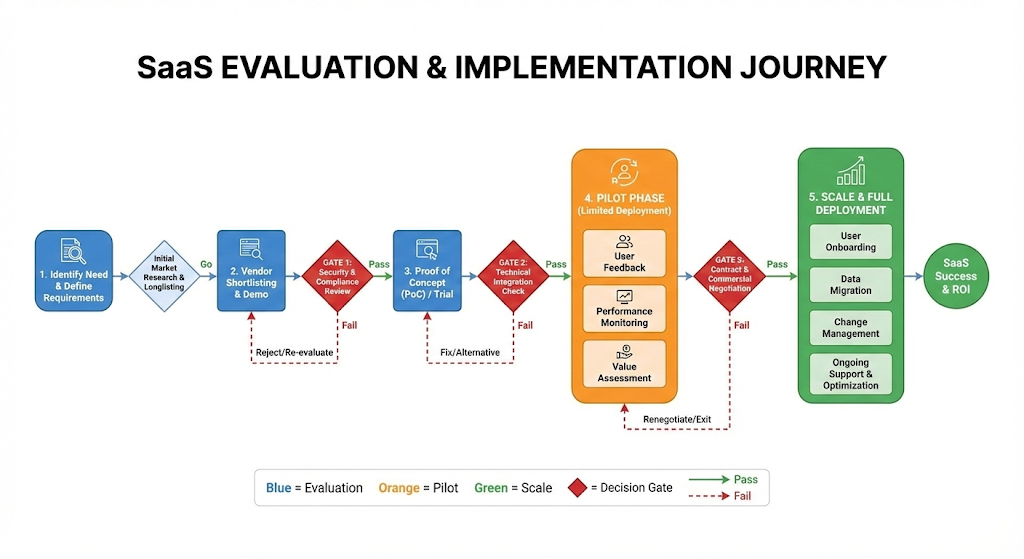
Step 4: Run a structured pilot with real users
Additionally, run a pilot that mirrors real work. Avoid toy demos.
Pick a small group of power users. Use live data where safe. Measure time saved and error reduction.
A pilot should feel revealing. It should also feel honest.
Step 5: Score the vendor like a partner, not a tool
Finally, evaluate the vendor relationship. This is emotional and rational.
Look for:
- Clear documentation
- Fast, respectful support
- Transparent incident handling
- A believable roadmap
- A mature security posture
Trust is not fluff. Trust is operational safety.
Pricing and contracts: how to avoid expensive surprises
Contracts decide your true cost. They also decide your freedom. This section is vital.
Common SaaS pricing models in 2025
Most SaaS pricing falls into a few patterns:
- Per user or per seat
- Tiered feature bundles
- Usage-based pricing
- Hybrid models (seats plus usage)
Usage-based pricing is rising, especially with AI features. This can be profitable for vendors. It can be risky for buyers.
So, insist on usage visibility. Ask for alerts. Ask for caps.
Negotiation levers that matter
However, you still have power, even with big vendors.
You can negotiate:
- Annual vs multi-year terms
- Price protection and uplift caps
- Minimum commitments
- Support tier inclusions
- Data export support
- Security add-ons and audit support
Even small improvements can be rewarding. They can also be critical at scale.
Clauses every serious buyer should review
Additionally, review these areas with care:
- SLA and service credits
- Data ownership and deletion timelines
- Subprocessor lists and notification rights
- Breach notification terms
- Termination rights for cause
- Change-of-control and acquisition language
These clauses protect you when things go wrong. That protection is priceless.
Security, privacy, and compliance in SaaS
Security is where confidence is earned. It is also where many buyers fail.
The shared responsibility reality
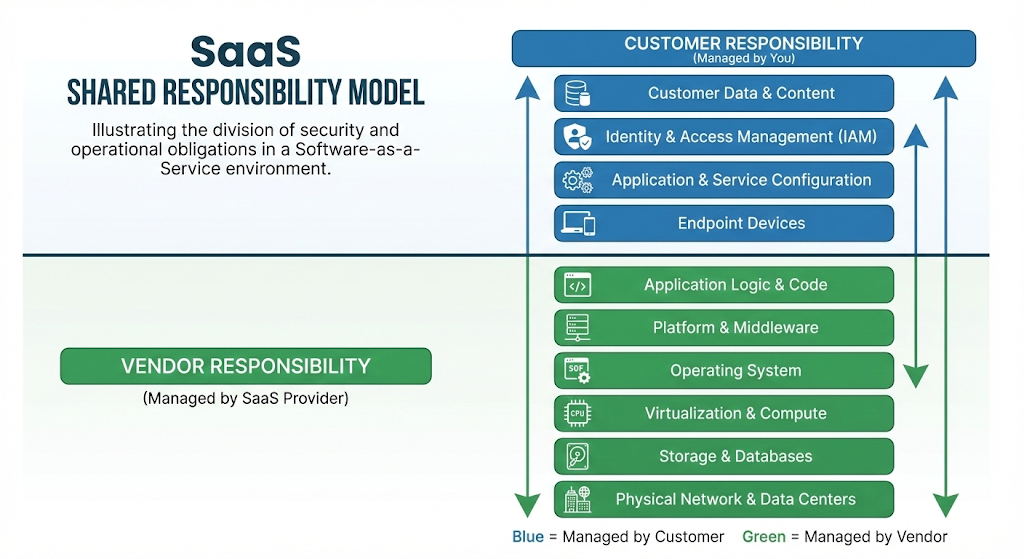
In SaaS, the vendor secures the platform. You still secure access, usage, and configuration.
That split is critical to understand. Misconfigurations can create huge exposure.
So, ask for clear responsibility boundaries. Demand clarity. Demand proof.
Identity-first security: your strongest control
Identity is the control plane for SaaS.
Use:
- SSO for centralized access
- MFA for strong authentication
- SCIM for automatic provisioning and deprovisioning
- Least privilege roles
- Regular access reviews
These steps feel boring. They are also proven. They reduce risk fast.
Compliance signals that build trust
Many buyers ask for SOC 2. Others ask for ISO 27001. These are strong trust signals.
The AICPA describes SOC 2 as an examination report on controls related to security, availability, processing integrity, confidentiality, and privacy. (AICPA & CIMA)
ISO/IEC 27001:2022 is a widely used information security management standard for building an ISMS. (ISO)
Also consider regional rules. In the EU, the NIS2 Directive sets a unified cybersecurity legal framework across critical sectors. (Digital Strategy)
You do not need to memorize every rule. You do need a repeatable assessment method.
SaaS security posture management is growing fast
Meanwhile, SaaS security posture management, often called SSPM, is becoming mainstream.
Why? Because SaaS stacks are large. Okta’s data shows app ecosystems keep expanding. (Okta)
SSPM tools help find risky settings. They help detect dangerous sharing. They can also reduce audit pain.
Implementation that actually sticks
Great SaaS can still fail. The reason is usually adoption, not features.
Change management: the difference between success and waste
Start with clear messaging. Explain why the tool matters. Show what pain it removes.
Train people in short sessions. Provide simple playbooks. Reward early wins.
Adoption should feel supportive. It should not feel forced.
Pilot, then scale with discipline
Additionally, scale only after the pilot proves value.
Lock a rollout plan. Define champions. Set support channels.
Avoid rolling out five new tools at once. That creates fatigue. Fatigue kills enthusiasm.
Governance: SaaSOps, FinOps, and AI policy
SaaSOps practices help you manage apps, licenses, and lifecycle.
FinOps practices help you control cloud and SaaS spend. The FinOps Foundation highlighted shifting priorities in 2024 toward reducing waste and managing commitments. (FinOps Foundation)
AI policy is also critical now. Microsoft and LinkedIn reported widespread BYOAI behavior. (Source)
So, define what data can be used with AI features. Make it clear. Make it enforceable.
SaaS metrics that prove value and protect you
If you cannot measure, you cannot manage. Metrics create clarity. Clarity creates confidence.
Adoption metrics that matter
Track:
- Active users vs paid seats
- Feature adoption for critical workflows
- Time saved on key tasks
- Support ticket volume and themes
These metrics reveal friction. They also reveal wins.
Risk metrics that reduce anxiety
Track:
- MFA coverage
- Orphaned accounts and stale access
- External sharing events
- Admin role counts
- Security configuration drift
Simple dashboards can be powerful. They also make audits less stressful.
Cost metrics that prevent silent waste
Additionally, track:
- Cost per active user
- License utilization
- Duplicate tool overlap
- Renewal calendar and term dates
- Unit costs for usage-based models
This is not just finance work. It is strategic control.
Building a SaaS stack that scales without chaos
SaaS is not one tool. It is an ecosystem. Ecosystems need architecture.
Integration patterns that keep things clean
Prefer a hub-and-spoke approach with identity at the center.
Use iPaaS when integrations multiply. Standardize event flows when possible. Keep documentation current.
Good integration design feels calming. Bad design feels fragile.
Automation that unlocks speed
Automate onboarding. Automate offboarding. Automate access requests.
This reduces human error. It also makes compliance easier.
Moreover, automation makes teams feel empowered. That feeling drives adoption.
Data foundations: avoid trapped information
Your SaaS tools create valuable data. That data should not be trapped.
Build a plan to:
- Export key datasets
- Centralize reporting
- Keep a single source of truth for core metrics
A solid data plan is rewarding. It also makes future migrations less scary.
The biggest SaaS trends shaping 2025 and beyond
Finally, let’s look forward. Trends help you buy wisely today.
AI agents and agentic workflows inside SaaS
AI copilots are evolving into agents. Agents can execute tasks, not just suggest.
This can be revolutionary for ops teams. It can also raise new risks.
So, demand audit logs for AI actions. Demand admin controls. Demand safe defaults.
Consolidation, platformization, and fewer “random tools”
Many firms want fewer apps. They want deeper platforms.
That push is visible in “suite” strategies. It is also visible in SaaS management platforms.
Okta’s data shows app counts rising overall. Yet cost pressure is intense. (Okta)
Therefore, buyers will keep consolidating. They will also demand clearer ROI.
Security rules and vendor risk will keep tightening
NIS2 is one example of stronger cybersecurity expectations. (Digital Strategy)
SOC 2 expectations remain common in vendor assessments. (AICPA & CIMA)
As a result, vendors with mature security will win. Buyers will also demand verified proof, not vague claims.
Cloud cost optimization stays a top priority
Flexera’s 2024 State of the Cloud findings show leading cloud adoption across AWS, Azure, and Google Cloud. (Flexera)
As cloud and SaaS costs rise, optimization becomes essential. FinOps practices support this shift. (FinOps Foundation)
In 2026, expect even stronger cost controls. Expect more usage visibility. Expect more value pressure.
Conclusion: a confident 30-day SaaS action plan
SaaS can be thrilling. It can also be risky. The difference is disciplined choice and strong governance.
Start with clarity. Define outcomes. Run a real pilot. Lock security controls early.
Then control costs with visibility. Treat contracts as critical. Measure adoption like a serious leader.
If you do these steps, SaaS becomes a proven advantage. It becomes safer. It becomes more rewarding. Your team becomes more confident. Your business becomes more resilient.
Sources and References
- Gartner: Public cloud spending forecast for 2025
- Gartner: Public cloud spending forecast for 2024
- IDC: Worldwide public cloud services spending forecast (2024)
- Flexera: 2024 State of the Cloud Report PDF
- Okta: Businesses at Work 2024 report PDF
- Microsoft: 2024 Work Trend Index article
- Microsoft News: 2024 Work Trend Index announcement
- EU Digital Strategy: NIS2 Directive overview
- AICPA: SOC 2 overview
- McKinsey: Tech trends outlook 2025