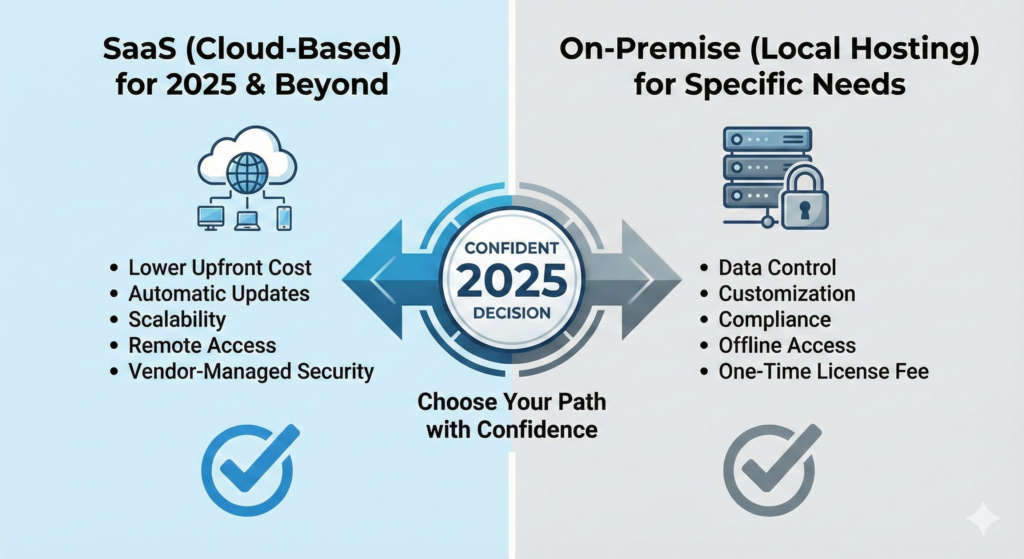
SaaS or on-premise? Make a confident 2025 decision with clear trade-offs on security, AI readiness, compliance, costs, and long-term control.
Why this decision feels urgent in December 2025
In December 2025, this choice feels less like an IT preference and more like a strategic, high-stakes bet. Generative AI is no longer a side project. It is shaping product cycles, customer expectations, and internal speed. Meanwhile, cyber risk keeps rising, and regulators keep tightening the screws. These forces make “wait and see” feel dangerous.
Additionally, most teams are running mixed environments now. A company might have SaaS for CRM, on-premise for core databases, and cloud for analytics. That hybrid reality is powerful, but it is also complex. Complexity creates friction. Friction creates delays. And delays can be costly when competitors ship faster.
However, urgency should not push you into a rushed decision. The most successful organizations treat SaaS and on-premise as tools, not identities. They match the platform to the workload, the risk level, and the talent they can actually hire and retain.
The AI acceleration effect
AI copilots, agentic workflows, and automated customer support are pushing companies to modernize data access and governance. That modernization is easier when systems are API-first and telemetry-rich. Many SaaS platforms are built that way by default. Yet, sensitive data and model oversight can demand tighter control.
The compliance squeeze
Data residency, auditability, and third-party risk reviews have become critical. ISO 27001 programs and SOC 2 expectations are common in B2B. These requirements influence where systems can live and how they must be operated. (ISO)
The talent reality
On-premise can be empowering. It can also be unforgiving. Hardware, patching, backups, incident response, and capacity planning require deep skills and relentless discipline. SaaS can reduce that burden, but it never removes responsibility entirely.
Clear definitions: SaaS, on-premise, and the modern middle
Before you compare, get brutally clear on what each option really means. Vague definitions create painful surprises later.
What SaaS actually is
SaaS is software delivered by a provider, usually via the internet, with the provider managing infrastructure, upgrades, and platform operations. You still own your data and identities. You still manage access, configuration, and how users behave. In many SaaS models, your biggest risk is misconfiguration, weak identity controls, or unsafe integrations. (Microsoft Learn)
What on-premise actually is
On-premise means your organization operates the software in your own facilities, or in a facility you fully control. You manage hardware, networking, storage, virtualization, patching, and the application stack. Control can feel empowering. Yet control is not automatically safety. If your patch cadence is slow, or your monitoring is weak, you are exposed.
The modern middle: private cloud, hosted, and hybrid
Today’s reality often sits between extremes. Private cloud on your hardware can deliver speed and automation. Hosted “single-tenant” deployments can provide strong isolation. Hybrid architectures can keep sensitive data close while still using SaaS for commodity functions. Gartner has pointed to hybrid cloud as a dominant operating model for large organizations. (Flexera)
What outcomes matter most for the business
A smart platform decision should map to business outcomes, not vendor slogans. Focus on a few decisive questions: How fast can you deploy? How safely can you operate? How confidently can you pass audits? How reliably can you scale?
Speed to value and execution confidence
SaaS often wins when time is critical. Provisioning is fast. Updates can be automatic. Teams can iterate quickly. That speed can feel like a breakthrough when the business is under pressure.
On-premise can still be fast, but only when your internal platform engineering is mature. If you already run Kubernetes, CI/CD, strong observability, and infrastructure automation, on-premise can deliver impressive agility. Without that maturity, delivery slows down.
Control, customization, and “fit”
On-premise offers deep customization. If your workflows are unusual, or you need custom modules, this can be vital. Some industries also need specialized integrations with legacy systems. That can be easier when everything is inside your perimeter.
SaaS configuration can be flexible, but it has boundaries. You get speed and upgrades, but you accept limits. When those limits block your differentiating workflow, frustration becomes inevitable.
Resilience and reliability expectations
SaaS providers often deliver strong uptime, multi-region design, and rapid recovery. Yet outages still happen. On-premise gives you direct control over resilience, but it also makes you responsible for designing and proving it.
Consequently, the right question is not “Which is more reliable?” The real question is “Which reliability model can we execute consistently?”
Security and risk: control is not the same as safety
Security is where many decisions go wrong. People confuse ownership with protection. Ownership can help. It can also hide dangerous gaps.
The shared responsibility reality
In cloud and SaaS, the provider secures the underlying infrastructure. You secure your data, identities, access policies, and usage patterns. If you misunderstand that split, you create a silent, high-impact exposure. (Microsoft Learn)
Zero Trust and identity-first protection
Zero Trust thinking has become essential. It treats every access request as untrusted until verified. That mindset reduces risk in both SaaS and on-premise. It shifts security from “network location” to identity, device posture, and continuous verification. (NIST Publications)
Supply chain risk and “shadow AI”
Modern breaches often involve third parties, credentials, misconfigurations, or hidden data sprawl. IBM’s 2024 report put the global average breach cost at USD 4.88 million, a sharp and alarming jump. (IBM)
In 2025, IBM’s reporting highlights a global average breach cost around USD 4.4 million, showing movement but not comfort. The risk remains critical. (IBM)
Meanwhile, the Verizon DBIR has highlighted huge real-world incident volumes and persistent credential-driven attacks. This is not abstract risk. It is operational reality. (Verizon)
Compliance, data residency, and sovereignty
Compliance is rarely optional. It is often a gatekeeper for enterprise deals, partnerships, and regulated operations. Even when you are not regulated, your customers may be.
Audit readiness and proof, not promises
Auditors and security teams want evidence. They want controls, logs, and repeatable processes. ISO/IEC 27001 is widely recognized for ISMS requirements, and SOC 2 is commonly demanded for service providers handling customer data. (ISO)
SaaS vendors may provide certifications and audit reports. That is valuable. Still, you must verify scope. You must confirm which services are covered. You must understand what remains your responsibility.
Data residency and “where the bytes live”
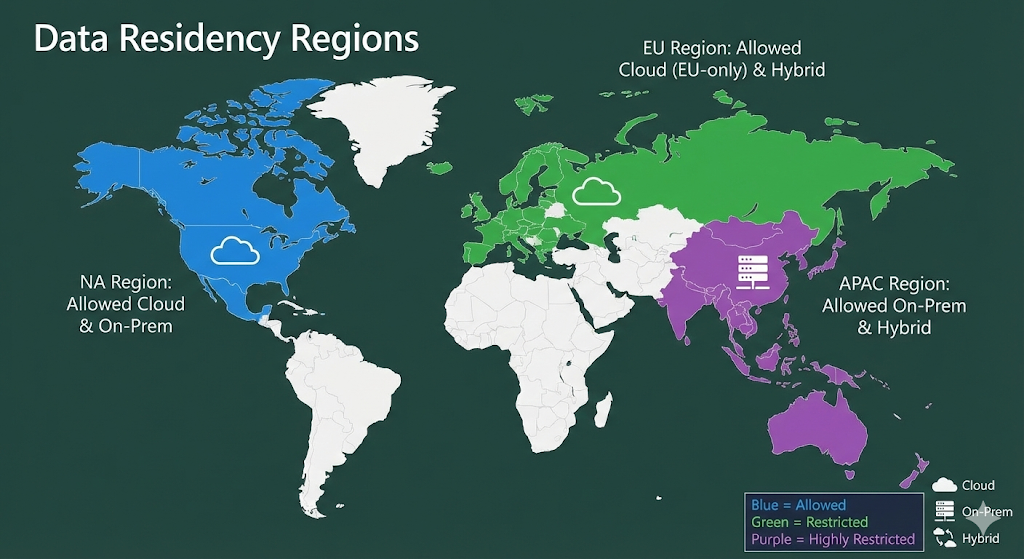
Data residency rules can force parts of a workload to stay in-country or in-region. This is a decisive factor in government, finance, and health. In these cases, on-premise or sovereign cloud options can be essential. Hybrid designs can also meet residency needs while still using SaaS where allowed.
Regulatory momentum and security spending pressure
Security investment continues to rise globally. Gartner has projected information security and risk management spending hitting about $213 billion in 2025, reflecting sustained urgency. (Gartner)
This pressure shapes platform choices. It makes governance, logging, and identity controls non-negotiable.
Total cost of ownership: beyond the price tag
Cost conversations often become emotional. Leaders fear waste. Teams fear constraints. A disciplined TCO view creates calm, credible decisions.
What you must include in TCO
TCO is not just licensing. It includes people, downtime, audits, integrations, security tooling, backup, disaster recovery, and ongoing improvement. SaaS can reduce infrastructure operations. On-premise can reduce certain recurring fees, but it increases operational workload.
Flexera’s research has repeatedly highlighted that managing cloud spend is a top challenge, and many organizations formalize FinOps practices to control it. (Flexera)
A common pattern appears: multi-cloud and hybrid are widespread, and FinOps teams are becoming mainstream. (ITPro Today)
Hidden costs that ambush on-premise teams
On-premise “hidden costs” often include:
Unplanned hardware refresh cycles, storage growth surprises, security patch emergencies, and talent churn. Also, incident response can be slower if tooling is weak. These costs feel especially painful when they hit during business-critical launches.
Hidden costs that ambush SaaS teams
SaaS “hidden costs” often include:
Integration complexity, data egress or migration effort, premium tiers for audit features, and dependency on vendor roadmaps. Additionally, contract renewal can create pressure if you are deeply embedded.
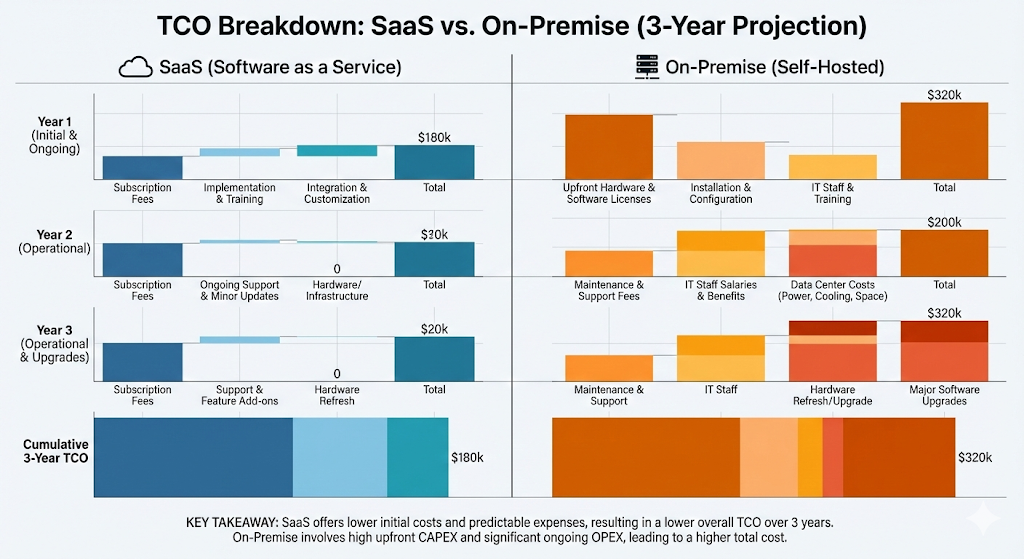
A simple 3-year TCO modeling approach
Start with a three-year horizon. List your major cost buckets. Use conservative assumptions. Then stress-test with two scenarios: growth and crisis.
A credible model includes:
People costs, vendor costs, security tooling, downtime impact, audit effort, and migration effort. The goal is not perfect prediction. The goal is decision clarity.
Performance, latency, and data gravity
Performance debates can get dramatic. Stay practical. The key is to match architecture to the physics of your workload.
When on-premise is a strong fit
On-premise can be a proven choice when you need ultra-low latency, tight hardware control, or specialized equipment. Manufacturing lines, edge inference, and sensitive research systems can fit this model well. It also helps when internet reliability is uncertain.
When SaaS is a strong fit
SaaS shines when distributed teams need access everywhere. It also shines when rapid scaling is necessary, and when global availability matters. Furthermore, SaaS can be excellent for commodity business functions where differentiation is low.
Hybrid as a performance compromise that can win
Hybrid can keep “hot data” close while using SaaS for workflows and collaboration. It can also reduce migration shock. However, hybrid must be engineered well. Poor integration creates latency, duplication, and frustration.
AI readiness: where your data lives shapes your future
AI is now a platform decision driver. It affects search, personalization, support automation, and internal productivity. Yet AI also introduces governance risk.
Copilots, agents, and real-world governance
Agentic AI can automate tasks across systems. That is exciting and powerful. It also increases blast radius. If identities are weak, agents can amplify mistakes at machine speed.
Therefore, identity governance, least privilege, and logging become vital. Shadow AI use can expose sensitive content in ways teams do not detect quickly.
Data pipelines and “AI-friendly” architecture
Modern AI features need clean data flows. They need APIs. They need event streams. They need observability. Many SaaS platforms are improving here, but integration remains decisive.
On-premise can support excellent AI pipelines, especially with mature MLOps and data engineering. Yet that maturity requires serious investment.
The safest AI path is often staged
Start with low-risk use cases. Keep sensitive data protected. Expand with controls. This staged approach feels slower, but it is often the most successful and least traumatic.
Integration and architecture: the connective tissue
Integration is where projects either thrive or collapse. It determines usability, data quality, and operational stability.
APIs, iPaaS, and event-driven patterns
SaaS usually provides APIs, webhooks, and connectors. That can be a breakthrough for speed. Yet unmanaged integrations can become a messy web. On-premise integration can be cleaner when you control everything, but it can also become fragile if built as point-to-point connections.
A robust approach uses:
Clear integration ownership, standardized event schemas, strong API governance, and reliable identity federation.
Identity and access as your control plane
In both models, identity is the true perimeter. Centralized IAM, MFA, device posture checks, and strong audit trails are essential. This is especially true when adopting AI copilots and automation agents.
Vendor lock-in vs operational lock-in
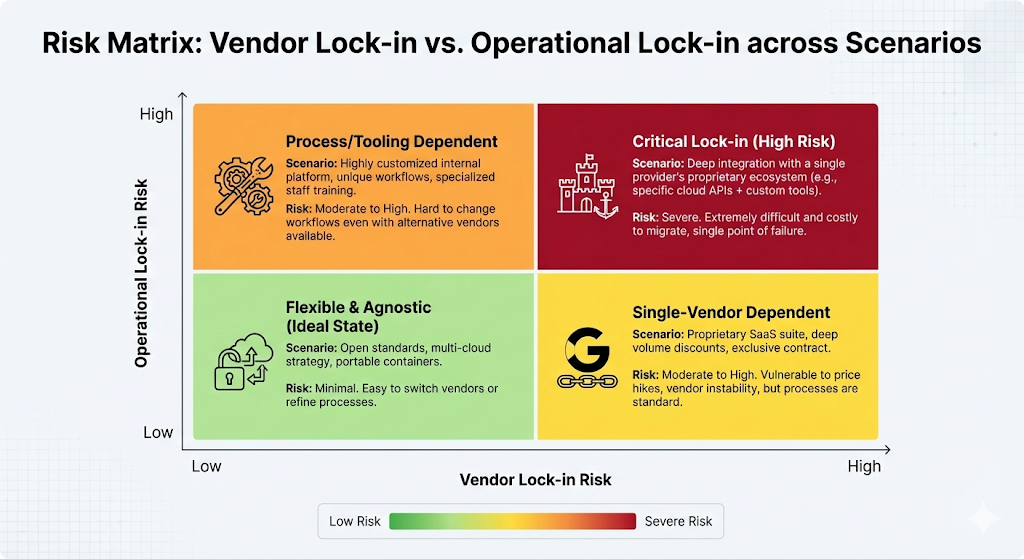
Lock-in is real. But it comes in more than one form. Many teams obsess over vendor lock-in and ignore operational lock-in.
What vendor lock-in looks like
Vendor lock-in can come from proprietary workflows, hard-to-export data models, unique automation scripts, or bundled AI features that do not port easily.
What operational lock-in looks like
Operational lock-in happens when only a few people understand the on-premise stack. If they leave, the business becomes fragile. This risk is quiet, but severe.
Consequently, the best choice is often the one you can operate confidently with your actual team.
Practical exit strategies
No matter what you choose, build an exit plan:
Define data export formats, test exports quarterly, document integrations, and negotiate contract clauses for portability. For on-premise, document everything, automate deployments, and reduce “hero knowledge.”
A practical decision framework you can use this week
Here is a simple, decisive framework. It is not perfect. It is effective.
The five-question test
Ask these five questions and answer honestly:
Do we need deep customization to compete?
Do we have the skills to operate securely at scale?
Are we constrained by residency or strict compliance demands?
Do we need rapid rollout across many locations?
Will AI adoption require tight control of sensitive data?
If most answers point toward speed and standardization, SaaS becomes compelling. If most answers point toward control and specialized needs, on-premise becomes compelling. If answers are mixed, hybrid is likely the smartest path.
A compact scoring matrix
Score each factor from 1 (low need) to 5 (high need). Then see which side dominates.
| Factor | SaaS advantage when… | On-premise advantage when… |
|---|---|---|
| Speed of deployment | You need fast rollout | You already have mature platform ops |
| Customization depth | Standard workflows are fine | Workflows must be unique |
| Compliance constraints | Vendor covers required controls | You need strict residency or isolation |
| Security operations | You need managed baseline | You can run world-class security yourself |
| AI governance | Vendor features fit your policies | You need full model and data control |
| Integration complexity | Connectors cover most needs | Legacy systems require deep internal wiring |
Additionally, revisit the matrix every 12 months. Needs change. Strategies evolve.
Common scenarios and what usually works best
Most organizations are not purely SaaS or purely on-premise. They choose based on workload types.
Fast-growing teams and multi-site companies
SaaS is often a rewarding choice when you need consistent processes across sites. It accelerates collaboration and simplifies access management. However, you still must invest in identity, logging, and configuration discipline.
Regulated industries and sensitive workloads
On-premise or sovereign deployments often win for strict residency and specialized controls. Hybrid can still deliver flexibility, but only with tight governance and careful segmentation.
AI-heavy products and data-sensitive innovation
A hybrid approach can be the most resilient and realistic. Keep sensitive data close. Use SaaS for collaboration and commodity workflows. Build controlled pipelines for AI training and inference.
Migration paths that reduce risk
If you are switching models, migration strategy matters as much as the destination.
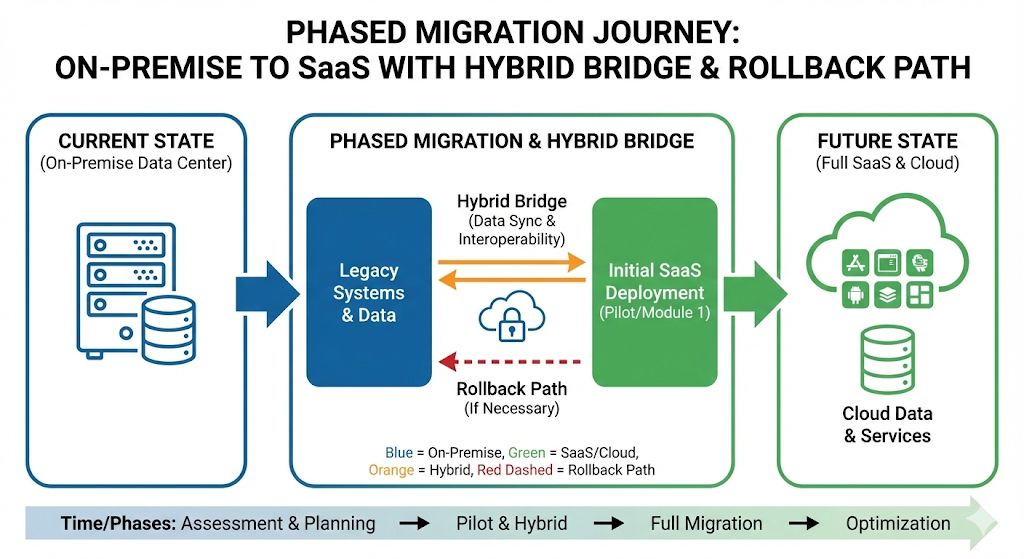
Start with a pilot that proves value
Pick a low-risk workload. Define success metrics. Measure security and performance. Then scale. This approach feels calm and controlled. It also builds trust.
Use phased migration, not a “big bang”
Phased migration reduces downtime risk. It also helps users adapt. Moreover, it exposes integration gaps early.
Modernize with the “strangler” pattern
Keep the old system running. Build new components around it. Move functions gradually. This pattern is slow, but it is proven and safe.
What to ask vendors and internal teams
This is where you avoid being sold a fantasy.
Ask for:
Clear shared responsibility boundaries. (Microsoft Learn)
Evidence of certifications and audit scope. (ISO)
Data export formats and timelines.
Incident response commitments and escalation paths.
AI governance controls, logging, and access management. (IBM)
Finally, demand clarity on what happens during outages, migrations, and contract renewals. Ambiguity is expensive.
Conclusion: a confident choice you can defend
In December 2025, the “right” choice is the one you can operate securely, prove in audits, and evolve with AI pressure. SaaS can deliver fast, reliable momentum. On-premise can deliver deep control and strong sovereignty. Hybrid can deliver a pragmatic blend that feels modern, resilient, and strategically safe.
However, the most critical success factor is not the platform. It is operational discipline. Strong identity controls, clear governance, serious monitoring, and tested recovery plans matter in every model. When you commit to those fundamentals, your choice becomes not only defensible, but genuinely empowering.
Sources and References
- Gartner cloud spending forecast for 2025 (public cloud end-user spending)
https://www.gartner.com/en/newsroom/press-releases/2024-11-19-gartner-forecasts-worldwide-public-cloud-end-user-spending-to-reach-723-billion-dollars-in-2025(Gartner) - Gartner security and risk management spending outlook for 2025
https://www.gartner.com/en/newsroom/press-releases/2024-03-05-gartner-forecasts-worldwide-security-and-risk-management-spending-to-exceed-215-billion-in-2024(Gartner) - Flexera 2024 State of the Cloud press release
https://www.flexera.com/about-us/press-center/flexera-2024-state-of-the-cloud-managing-spending-top-challenge(Flexera) - Summary of key Flexera findings (multi-cloud, FinOps, CCOE)
https://www.itprotoday.com/cloud-computing/cloud-adoption-soars-as-organizations-navigate-challenges(ITPro Today) - IBM Cost of a Data Breach Report 2024 (PDF)
https://cdn.table.media/assets/wp-content/uploads/2024/07/30132828/Cost-of-a-Data-Breach-Report-2024.pdf(Table Media) - IBM Cost of a Data Breach Report 2025 (interactive report page)
https://www.ibm.com/reports/data-breach(IBM) - Verizon 2024 Data Breach Investigations Report (PDF)
https://www.verizon.com/business/resources/reports/2024-dbir-data-breach-investigations-report.pdf(Verizon) - NIST SP 800-207 Zero Trust Architecture (PDF)
https://nvlpubs.nist.gov/nistpubs/specialpublications/NIST.SP.800-207.pdf(NIST Publications) - ISO/IEC 27001 standard overview
https://www.iso.org/standard/27001(ISO) - FinOps Foundation: “What is FinOps?” (updated 2025)
https://www.finops.org/introduction/what-is-finops/(FinOps Foundation)