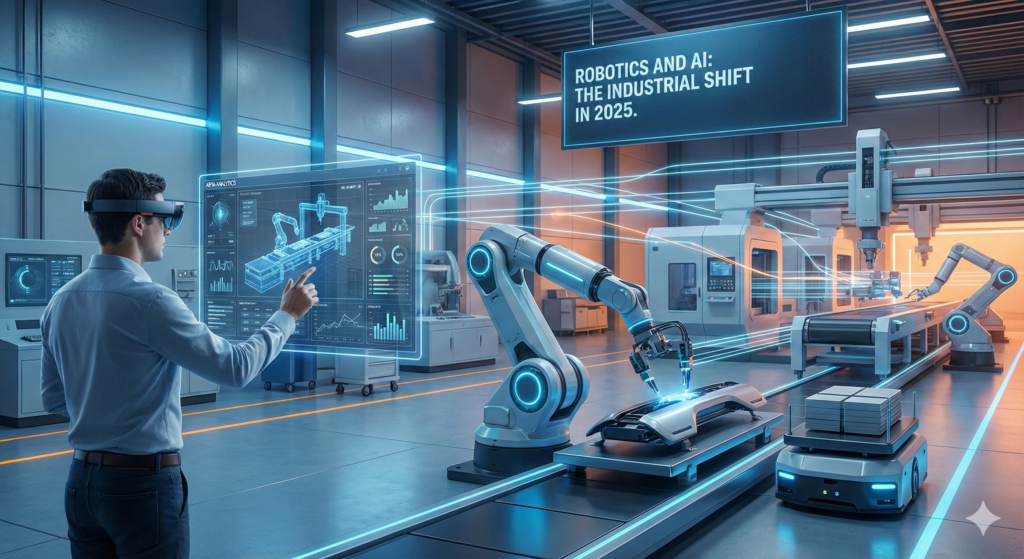
Robotics and AI are reshaping industry faster than most leaders expect. Discover the breakthroughs, risks, and practical moves to adopt automation safely.
As of December 2025, robotics is no longer “just automation.” It is becoming a learning system that senses, decides, and improves. That shift is already changing what factories build, how warehouses move goods, and how teams manage safety and quality. The mood in many boardrooms is a mix of excitement and pressure. The opportunity feels massive, but the path can feel complex.
This article breaks down what is truly changing, where results are most proven, and how to move from pilots to scaled impact without painful surprises.
The 2025 inflection point
The story is not simply “more robots.” Instead, it is smarter robots, connected robots, and robots that fit messy real work.
From scripts to learning systems
For decades, industrial robots followed strict programs. They were powerful, but brittle. A small change in a part’s position could ruin a cycle. AI changes that by giving robots adaptive perception and flexible behavior.
Computer vision can now recognize parts in clutter. Modern motion planning handles uncertainty better. In many plants, this is the difference between a robot that works only in perfect conditions and one that works on a real line with real variation.
Consequently, industries are shifting from “automation islands” to “automation flows.” A robot cell can talk to a quality system, a scheduling tool, and a maintenance platform. That connection is often a bigger breakthrough than the robot arm itself.
Data, compute, and the edge advantage
Industrial environments create oceans of data: cameras, force sensors, lidar, torque curves, vibration signals, and cycle timestamps. The best teams treat that data like a strategic asset. They build pipelines that feed continuous improvement.
Meanwhile, compute is moving closer to machines. Edge AI reduces latency and improves reliability when networks are weak. It can also support privacy and security goals by keeping sensitive data on-site.
This shift matters because robotics is time-critical. A grasp decision that arrives late is a failed pick. Edge AI helps robotics feel instant, smooth, and more human-ready.
The adoption surge is measurable
The growth is no longer anecdotal. The International Federation of Robotics reported 542,000 industrial robots installed in 2024, with the global operational stock reaching 4,664,000 units in 2024. (IFR International Federation of Robotics)
Additionally, global robot density keeps climbing. IFR reported a global average of 162 robots per 10,000 employees in 2023, more than double the level measured seven years earlier. (IFR International Federation of Robotics)
Robots you see in real plants today
Robotics looks different depending on the site. Some environments need safe collaboration. Others need speed and scale. The winners mix the right robot type with the right AI.
Cobots and the rise of human-centered automation
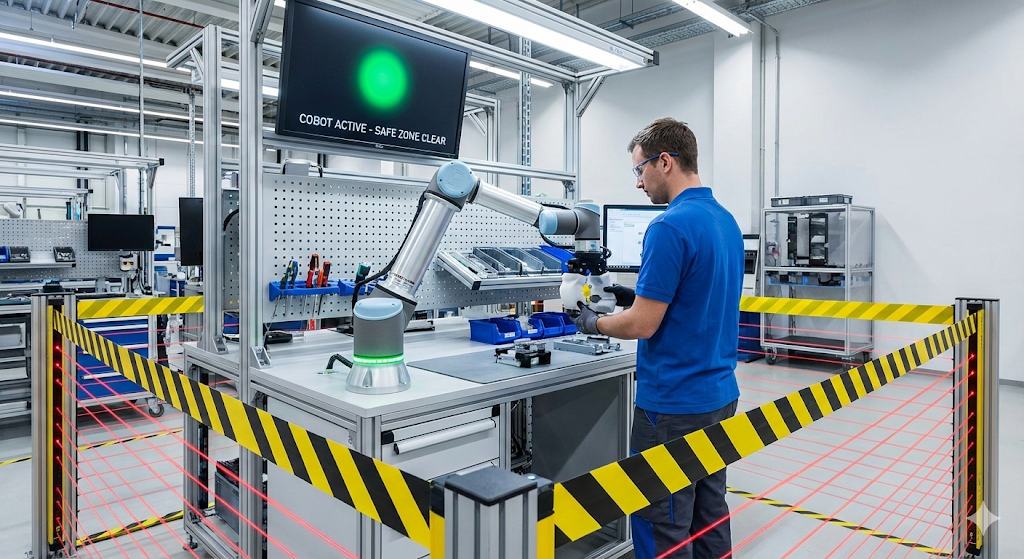
Collaborative robots, or cobots, thrive where space is tight and tasks change often. They support a very practical promise: automate the dull work while people handle exceptions, judgment, and craftsmanship.
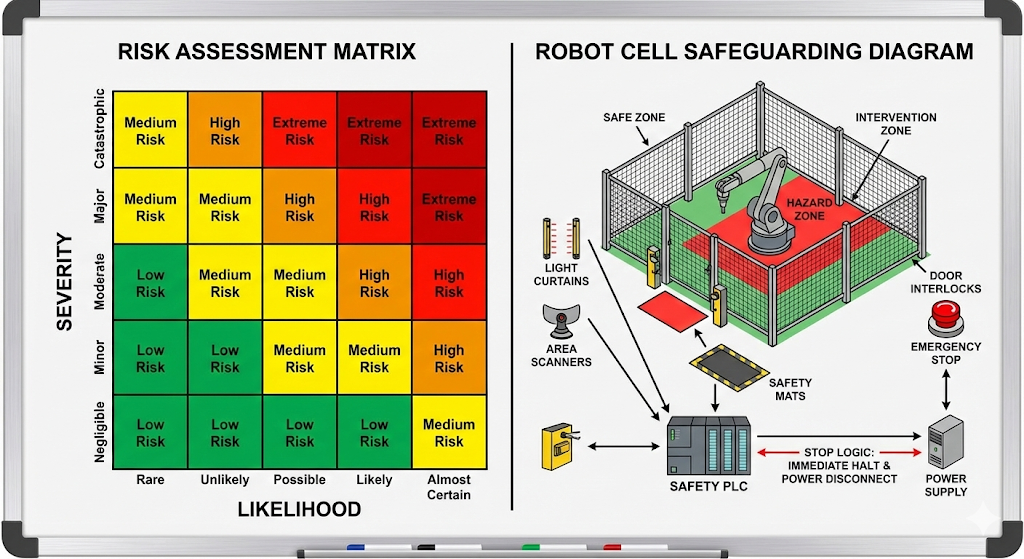
However, cobots are not magical. They still need careful integration, guarding logic, and risk assessment. Their true value is flexibility. When product variants explode, cobots can be redeployed faster than classic fixed automation.
This is where “Industry 5.0” ideas become real. The most successful deployments are human-centered. They reduce strain, improve ergonomics, and make outcomes feel rewarding for operators, not threatening.
AMRs turn warehouses into living systems
Autonomous mobile robots (AMRs) are now a core tool for logistics and manufacturing plants. They move parts, totes, pallets, and carts through changing layouts. Unlike old AGVs, many AMRs can navigate more dynamically.
In practice, AMRs shine when demand is volatile. You can add robots during peaks and reduce them later. That elastic model is one reason service robots keep growing.
IFR reports that professional service robot sales reached almost 200,000 units in 2024, up 9%, with transport and logistics among the top application classes. (IFR International Federation of Robotics)
Vision-guided picking is finally scaling
Picking random objects is one of robotics’ hardest problems. It sounds simple, yet it requires robust perception, grasp planning, and real-time correction. The good news is that AI has pushed bin-picking and piece-picking forward fast.
Additionally, tactile sensing is emerging as a serious advantage. In warehouses, touch helps when vision fails due to glare, occlusion, or packaging variation.
Large-scale operators are openly discussing this shift. Amazon describes deploying more than 1 million robots across its operations network since 2012, spanning mobile drive units and robotic arms. (About Amazon)
The AI stack behind modern robotics
Robots do not become “smart” by accident. They become smart when teams build a full stack: perception, decision-making, control, and continuous learning.
Perception: seeing the world clearly
Perception is the gateway skill. Cameras and depth sensors feed models that detect objects, estimate pose, track movement, and classify defects. The most important improvement in 2024-2025 is robustness under messy lighting and messy backgrounds.
Furthermore, multimodal perception is becoming common. Vision can combine with force signals, audio anomalies, and vibration patterns. That fusion makes decisions more reliable and verified by multiple signals.
Quality inspection is a clear example. Vision models can spot surface defects that humans miss at speed, but they need calibrated lighting and strong data governance to stay trustworthy over time.
Planning and control: from “if-then” to intent
Planning answers “what should the robot do next?” Control answers “how does it do it safely?” AI now supports both, but the balance matters.
A critical trend is the move toward higher-level intent: “pick that part and place it here,” with the robot choosing the exact motion. That can cut engineering time. It can also introduce risk if teams skip validation.
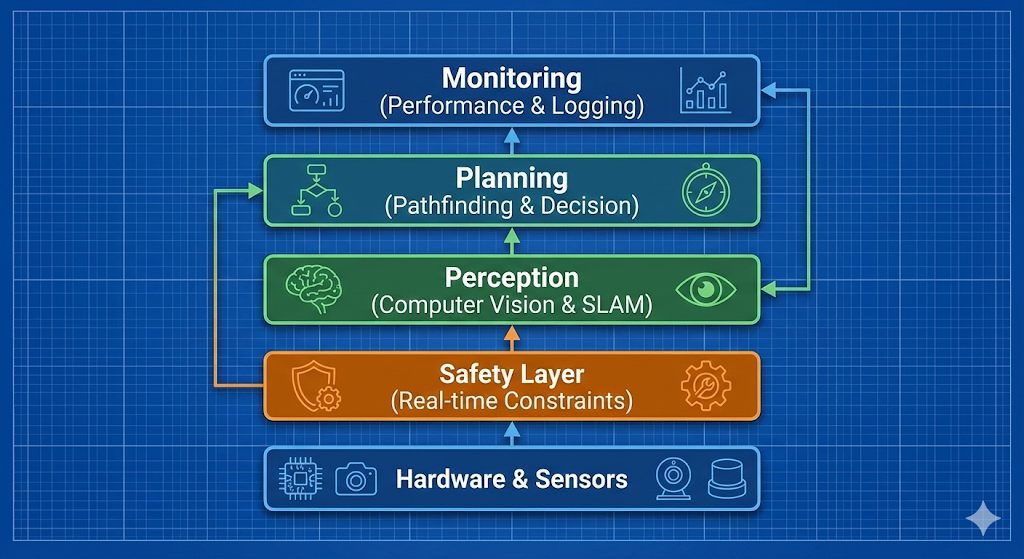
Consequently, many advanced deployments keep a layered approach:
- deterministic safety layers for limits and emergency behavior
- learning layers for perception and task flexibility
- monitoring layers for anomaly detection and audit trails
This mix helps keep operations safe, traceable, and still fast.
Digital twins and simulation accelerate learning
Digital twins are not hype when used correctly. They let teams test layouts, cycle times, and safety zones before hardware arrives. They also support synthetic data generation for training perception and control policies.
Meanwhile, simulation helps with rare events. You cannot wait for a real crash to learn from it. You can simulate near-misses, slippery parts, or unexpected obstacles.
This is why “industrial metaverse” language persists. It signals a shift toward virtual commissioning, continuous optimization, and faster ramp-up with less downtime.
Industry-by-industry changes
Robotics and AI are touching nearly every major sector, but the shape of change varies. The smartest leaders anchor strategy in real workflows, not slogans.
Manufacturing: flexibility beats raw speed
In manufacturing, the biggest win is flexibility. Plants want shorter changeovers, smaller batches, and stable quality. AI-enabled robotics helps when product mix changes weekly.
Additionally, predictive maintenance reduces painful line stops. Sensors can detect anomalies early. That makes uptime feel more secure and less chaotic. When combined with automated quality inspection, the system can correct problems before scrap piles up.
Robot density trends confirm momentum. IFR’s 2024 reporting shows continued acceleration across key manufacturing economies. (IFR International Federation of Robotics)
Logistics and fulfillment: scale and ergonomics
Warehouses are transforming into adaptive systems. Robots handle transport, sortation, and a growing share of picking. Humans focus more on exception handling and supervision.
Amazon’s public materials emphasize that robots support operations across many sites and tasks. (About Amazon) This matters because it proves robotics is no longer limited to a few showcase facilities. It can be industrialized.
However, the most vital lesson is ergonomics. The best deployments reduce climbing, bending, and heavy lifting. That builds trust. It also lowers injury risk, which is a critical benefit.
Healthcare and labs: precision under strict constraints
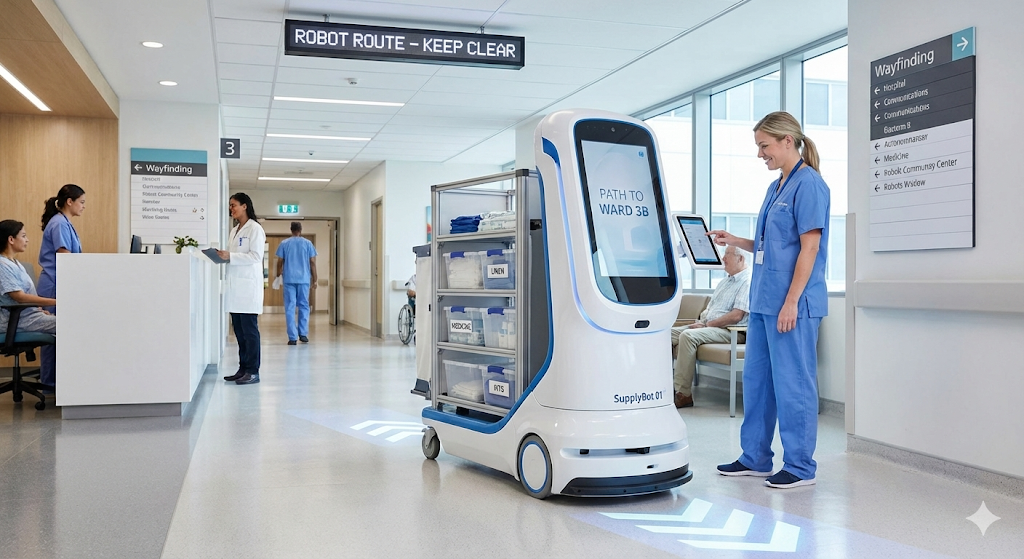
Healthcare robotics is a different world. Safety and compliance are intense. Still, progress is strong because the value is clear: precision, repeatability, and reduced strain.
In labs and pharma, automation supports sample handling, high-throughput screening, and sterile workflows. AI can improve scheduling and anomaly detection, helping teams catch issues early.
Consequently, robotics in healthcare often advances through “tight scope” wins. It starts with logistics robots or lab automation, then expands as trust grows and workflows stabilize.
What this means for people and jobs
Robotics changes work. The outcome can be empowering or disruptive. The difference is leadership, training, and transparency.
New roles are emerging fast
Automation shifts demand toward technicians, integration engineers, robot operators, safety specialists, and data quality roles. It also increases the need for “process owners” who understand both operations and technology.
Additionally, many teams need AI governance skills now. Someone must own model updates, drift monitoring, and incident response. Without that ownership, trust collapses.
This is a proven pattern: technology adoption fails less from hardware limits and more from missing operating models.
Safety culture becomes the real competitive edge
A strong safety culture is not bureaucracy. It is speed. When teams trust safety, they move faster. When they fear it, every change becomes political.
Consequently, leading sites treat safety work as a daily habit:
- clear lockout and validation routines
- visible incident learning
- certified training paths for operators and technicians
“Certified” matters here in a practical way. People want clear proof that systems meet standards and that leaders take responsibility seriously.
Training builds trust and momentum
Training is the calm antidote to fear. Operators who understand what a robot can and cannot do are more confident. They also spot issues early.
Meanwhile, cross-training helps. When maintenance teams understand AI-driven inspection, they can diagnose problems faster. When data teams understand the line, they label data correctly and avoid costly mistakes.
The result is a more resilient organization, not just a more automated one.
Safety, regulation, and cyber resilience
As robots get smarter, the risk surface expands. Safety and compliance are not optional. They are essential for sustainable adoption.
The EU AI Act matters for industrial AI
The EU’s AI Act is now a concrete timeline, not theory. The European Commission states the AI Act entered into force on 1 August 2024, becomes fully applicable on 2 August 2026, with key phases including prohibited practices and AI literacy obligations from 2 February 2025, and general-purpose AI obligations from 2 August 2025. (Digital Strategy)
For industry, the message is clear: document systems, manage risk, and build governance. Even outside Europe, this regulation influences global procurement and vendor expectations.
Additionally, some high-risk AI rules embedded into regulated products have extended transition periods, which affects how industrial suppliers plan compliance. (Digital Strategy)
Safety standards give a stable foundation
Robotics safety has mature standards. Two that come up constantly are ISO 10218 and ISO/TS 15066. ISO describes ISO/TS 15066 as specifying safety requirements for collaborative industrial robot systems and work environments, supplementing ISO 10218 guidance. (ISO)
ISO also published updated robotics safety requirements in ISO 10218-1:2025 and ISO 10218-2:2025, covering safety requirements for industrial robots and their integration into applications and cells. (ISO)
Furthermore, functional safety concepts matter when robots and AI touch safety-related functions. IEC highlights functional safety approaches and the IEC 61508 family as a foundation for safety lifecycle thinking. (IEC)
Cybersecurity becomes physical security
A cyber incident in robotics is not just data loss. It can be downtime, damaged equipment, or unsafe behavior. That raises the stakes.
Therefore, robotics programs need serious basics:
- segmented networks for OT and IT
- strong identity and access controls
- secure update pipelines
- monitoring for anomalies in motion and sensor patterns
Additionally, AI introduces new risks like prompt injection in operator tools, model spoofing, and data poisoning. The best teams treat these risks as manageable, not mysterious, with clear controls and incident drills.
How to adopt robotics and AI successfully
Most failures come from strategy and execution, not from the robot. The goal is to be ambitious and disciplined at the same time.
Choose a first use case that is both simple and valuable
Start where value is obvious and measurement is easy. Good first targets are repetitive handling, internal transport, quality inspection, or packaging.
However, avoid the “demo trap.” A flashy pilot that cannot scale destroys trust. A modest pilot that scales is powerful.
A practical test is to ask three questions:
- Can we define success in numbers and time?
- Do we control the data needed to run and improve it?
- Can we integrate safely without halting production?
If the answers are clear, the project is likely viable.
Pilot, measure, then scale with discipline
A pilot should be short, but not rushed. It needs safety validation, operator training, and a clear handoff plan. The moment you scale, small issues multiply.
Consequently, define a scale playbook early:
- standard cell designs and wiring patterns
- verified commissioning checklists
- reusable data pipelines and dashboards
This is where teams feel real momentum. Scaling becomes repeatable, not heroic.
Build governance like it is part of production
Governance sounds dry. In reality, it protects speed. It answers: who approves model updates, who monitors drift, and who responds to incidents?
NIST’s AI Risk Management Framework is widely referenced because it offers a structured way to think about trustworthy AI across design, deployment, and monitoring. (NIST)
Additionally, NIST published a generative AI profile companion to AI RMF, reflecting how fast real-world AI use is evolving. (NIST Publications)
A governance layer makes decisions feel transparent, authentic, and easier to defend during audits.
The next wave through 2028
Robotics is entering a new chapter. The next wave is about generality, dexterity, and coordination across many machines.
Generalist robotics and humanoids enter serious trials
Humanoid robots are moving from spectacle to early work trials in controlled settings. Progress is still uneven, but capability is climbing. The excitement is real, yet expectations must stay grounded.
Furthermore, major AI and hardware players are pushing “physical AI” narratives. Nvidia’s GTC 2025 announcements around robotics foundation models helped intensify that trend. (AP News)
The strategic takeaway is simple: humanoids may first win where environments are built for humans and tasks are varied, but the safety and validation bar will stay extremely high.
Multi-robot coordination and swarm-like thinking
Warehouses already coordinate fleets of AMRs. The next step is richer cooperation: robots sharing maps, task intent, and learned experience.
Meanwhile, research in swarm robotics and distributed autonomy keeps advancing. This matters for large sites, disaster response, and infrastructure inspection, where centralized control can be fragile.
For industry, the near-term value is better orchestration. It reduces traffic jams, increases throughput, and makes systems feel smooth under stress.
Sustainable automation becomes a serious KPI
Energy costs and sustainability targets push robotics teams to optimize motion, idle time, and compute efficiency. Efficient automation is not only greener. It is also cheaper to run and easier to cool and maintain.
Additionally, organizations are paying more attention to lifecycle impacts: repairability, modular upgrades, and responsible disposal. That focus can turn a robotics program into a thriving long-term capability instead of a short-lived project.
Conclusion
Robotics and AI are changing industry because they turn rigid automation into adaptive systems. The shift is already measurable in installations, density, and service robot adoption. (IFR International Federation of Robotics)
In December 2025, the most successful leaders are not chasing hype. They are building trusted, verified, safety-first programs that scale. They start with a clear use case, invest in data and governance, and respect the human side of change. That combination is the real breakthrough.
Sources and References
- IFR: Global robot demand doubles over 10 years
- IFR: Global robot density in factories doubled
- IFR: Service robots see global growth boom
- European Commission: AI Act timeline and key dates
- EUR-Lex: Regulation (EU) 2024/1689 text
- NIST: AI Risk Management Framework overview
- ISO: ISO/TS 15066 collaborative robot safety
- ISO: ISO 10218-1:2025 industrial robot safety requirements
- ISO: ISO 10218-2:2025 robot application and cell safety
- Amazon: Robots inside fulfillment centers overview
- McKinsey: Top trends in tech for 2025