Discover how AI, GenAI copilots, and agents reshape digital transformation in 2025, with practical steps to scale fast, safely, and confidently.
Why AI became the engine of transformation in 2025
Digital transformation used to mean one big thing: moving from paper to software. That era is over. In December 2025, transformation is deeper and more demanding. It is about speed, resilience, trust, and constant reinvention.
Artificial intelligence sits at the center of that shift. Not as a side project. Not as a lab toy. AI is now the operational nerve system that makes modern digital work possible.
This matters because competition is brutal. Customers expect instant service. Regulators expect clear controls. Employees expect better tools. Meanwhile, costs keep rising. Consequently, leaders feel a critical pressure to do more with less, without losing quality.
Here is the breakthrough idea: AI turns digital from “systems of record” into “systems of action.” Instead of only storing data, your stack starts deciding, predicting, generating, and guiding work. That is the real step change.
McKinsey’s 2025 global survey captures this momentum. It reports that 88% of respondents say their organizations use AI regularly in at least one business function. It also shows that many are still stuck in pilots, which is the most frustrating phase. (McKinsey & Company)
So the story is not “AI is coming.” The story is “AI is here, but value is uneven.” That gap is where digital transformation wins or fails.
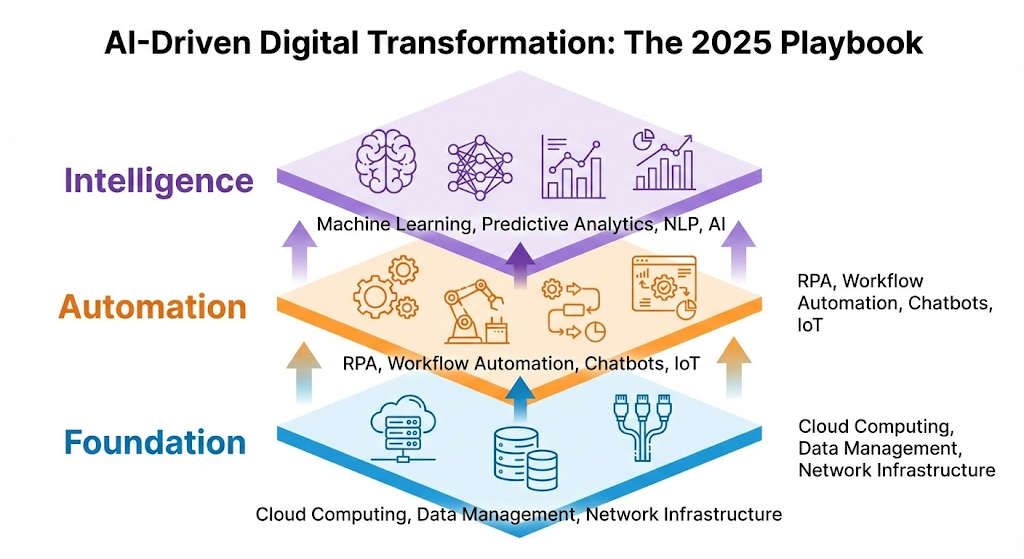
Digital transformation now has three layers
First comes digital foundation. This includes cloud, APIs, cybersecurity, and data platforms. Next comes automation at scale. This is workflow redesign, integration, and operational discipline. Finally comes intelligence everywhere. That is AI in products, processes, and decisions.
Importantly, the top layer cannot survive without the first two. Many teams skip ahead. They chase a dazzling chatbot. Then trust breaks. Users disengage. Value evaporates.
The emotional reality leaders face
AI transformation feels thrilling and risky at the same time. There is excitement, because results can be dramatic. There is also fear, because mistakes can be public and costly.
However, the best leaders treat that tension as useful fuel. They move with urgency, but they build guardrails early. They aim for measurable impact, not hype.
From analytics to GenAI to agents
AI is not one thing. It is a family of capabilities. Each capability changes transformation in a different way.
Traditional machine learning predicts outcomes. It flags fraud. It forecasts demand. It optimizes routes. That work remains essential and profitable, especially in operations.
Generative AI is different. It creates text, code, images, and summaries. It also powers copilots that help people work faster. This is why it feels revolutionary. It touches every desk job.
Now a third wave is rising: agentic AI. Agents do not just answer. They plan, take steps, and complete tasks across tools. Gartner highlights “Agentic AI” as a top strategic technology trend for 2025. It predicts that by 2028, at least 15% of day-to-day work decisions will be made autonomously through agentic AI, up from 0% in 2024. (Gartner)
McKinsey’s 2025 survey also shows intense curiosity in agents. It reports 23% scaling an agentic AI system somewhere, plus 39% experimenting. (McKinsey & Company)
So the practical lesson is clear: digital transformation now needs a roadmap across all three waves.
Why GenAI spreads so fast
GenAI is simple to try. You can paste text into a tool and see value in seconds. That instant feedback is powerful. It creates belief. It also creates risk, because teams deploy before they design controls.
Microsoft’s AI diffusion research illustrates scale. It describes a world where AI use is spreading across society, not just tech teams.
Therefore, transformation leaders should assume one fact: employees will use GenAI with or without permission. The critical choice is whether you make it safe and useful.
Why agents change the transformation game
An agent can watch a ticket queue, gather context, propose actions, and execute steps. It can open a case, update a record, generate a customer reply, and schedule a follow-up. That is not “automation in one app.” It is automation across the work graph.
This is why agents feel like a breakthrough workforce multiplier. Still, they also amplify failure modes. If an agent is wrong, it can be wrong faster. If it is insecure, it can leak more data. Consequently, governance becomes vital.
What “AI-powered transformation” looks like in real business terms
The most credible transformations are not defined by models. They are defined by outcomes. Leaders want faster cycles. They want higher customer satisfaction. They want safer operations. They want verified compliance.
So ask a simple question: where does work get stuck today?
AI shines in bottlenecks that share three traits:
- Too much information for humans to process.
- Repetitive decisions that drain time.
- High cost of delays or errors.
Additionally, AI works best when you can connect it to action. A model that only produces insight is helpful. A system that turns insight into guided next steps is far more rewarding.
Customer experience becomes predictive and personal
Digital transformation once meant “add a chat widget.” Now it means “predict the need before the customer asks.”
AI enables proactive service. It can detect churn risk. It can recommend a retention offer. It can route a case to the best agent. It can summarize history instantly.
The emotional payoff is huge. Customers feel understood. Agents feel supported. Brands feel modern and trustworthy.
Operations shift from reactive to resilient
In supply chains and production, AI helps you see weak signals early. It can forecast demand. It can optimize inventory. It can detect anomalies in sensor data. It can predict failures before they happen.
Moreover, AI supports digital twins. It lets you simulate scenarios safely. That makes decisions more confident and less chaotic.
Software delivery becomes faster and cleaner
GenAI copilots accelerate coding, testing, and documentation. They also speed up incident response by summarizing logs and proposing fixes. McKinsey’s 2025 survey notes that cost benefits are often reported in software engineering and IT. (McKinsey & Company)
However, speed without discipline can be dangerous. Teams must keep review, testing, and security scanning strict. That is non-negotiable.
The foundation most teams underestimate: data, identity, and architecture
AI can feel magical. Yet it is deeply dependent on plumbing. If your data is messy, outputs will be messy. If access control is weak, risk becomes severe.
So a practical AI transformation starts with three foundational moves.
1) Build a trusted data layer
You need clear data ownership. You need quality checks. You need lineage. You need permissioning.
This is where modern patterns help: data mesh, lakehouse, event streaming, and semantic layers. Use what fits. Do not chase fashion. Choose what makes data usable and verified.
Deloitte’s 2024 GenAI research also points to the hard truth: scaling and value creation is demanding work. It highlights data and governance as critical to scaling. (Deloitte)
2) Treat identity as the control plane
AI touches everything. So identity must be consistent across apps, APIs, and data. Strong IAM is not boring. It is essential.
Use least privilege. Use just-in-time access. Log model access like you log admin access. Additionally, protect secrets like your business depends on it, because it does.
3) Design an “AI-ready” architecture
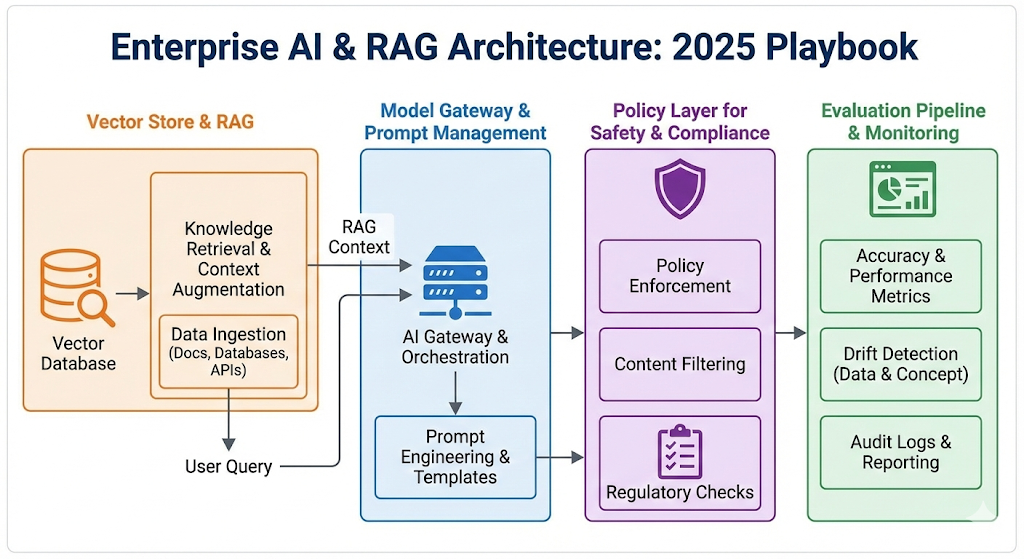
An AI-ready architecture is modular. It has APIs. It has observability. It supports experimentation without chaos.
In practice, this often includes:
- A model gateway and prompt management
- A vector store for retrieval augmented generation (RAG)
- A policy layer for safety and compliance
- An evaluation pipeline for accuracy and drift
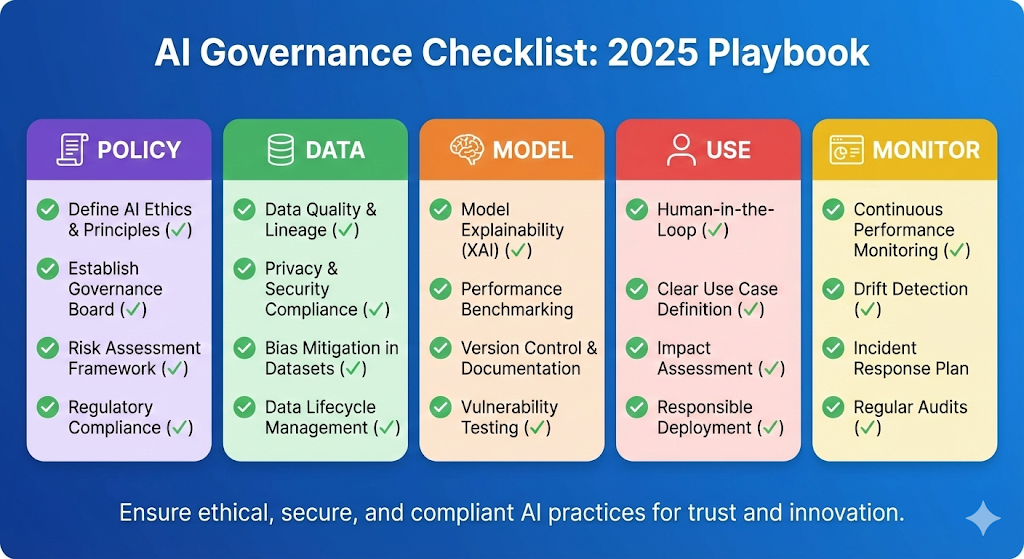
Governance, risk, and trust are now central to transformation
A few years ago, governance felt optional. In 2025, it is a competitive advantage.
Trust is emotional. When users trust AI, they adopt it. When they fear it, they avoid it. Consequently, the best transformations invest early in transparency and control.
What “responsible AI” means in daily work
Responsible AI is not a slogan. It is a set of operational habits:
- Clear use-case approval
- Risk tiering for systems
- Human oversight rules
- Testing for bias and harmful content
- Logging, audits, and incident response
Gartner also calls out “AI Governance Platforms” as a key 2025 trend, tied to its TRiSM framework. It predicts that by 2028, organizations with comprehensive AI governance platforms will see 40% fewer AI-related ethical incidents than those without. (Gartner)
That is a serious incentive. It is also a serious warning.
Regulation is real, and timelines matter
If your business touches Europe, the EU AI Act timeline is critical. The European Commission notes the Act entered into force on 1 August 2024, with staged applicability. It also notes that prohibited AI practices and AI literacy obligations apply from 2 February 2025, and obligations for general-purpose AI models become applicable on 2 August 2025. (Digital Strategy)
Even if you are outside the EU, these rules influence global standards. Vendors adapt their products. Customers demand stronger documentation. Therefore, compliance readiness becomes a vital transformation goal.
Standards can reduce chaos
Two frameworks help teams move from fear to clarity:
- NIST AI Risk Management Framework (risk framing and controls) (NIST)
- ISO/IEC 42001 (an AI management system approach) (ISO)
You do not need perfect compliance on day one. Still, you need a credible plan. That plan builds trust with regulators, customers, and your own employees.
Talent and change management decide success
Technology is the loud part. People are the decisive part.
Transformation fails when employees feel replaced, confused, or ignored. It succeeds when employees feel empowered, trained, and protected.
McKinsey’s 2025 survey reports varied expectations on workforce impact. Some expect decreases, others no change, others increases. (McKinsey & Company) This uncertainty is emotionally intense. Leaders must address it directly.
The best organizations build “AI literacy” fast
AI literacy is no longer nice. It is urgent. It includes:
- What AI can do well
- Where it fails
- How to validate outputs
- How to handle sensitive data
- How to report issues
Additionally, literacy reduces risk. It improves adoption. It builds confidence.
Copilots need new work habits
A copilot is not autopilot. People must learn to ask better questions. They must learn to verify sources. They must learn to keep drafts separate from final decisions.
Deloitte’s 2024 findings suggest most organizations are still scaling carefully. It reports that the vast majority (74%) say their most advanced GenAI initiative is meeting or exceeding ROI expectations, while many still need time to resolve adoption and ROI challenges. (Deloitte)
That combination is important. Value is real. Work remains hard.
Culture matters more than tools
If teams fear punishment for mistakes, they hide problems. If teams feel safe, they report issues early. That creates a healthy learning loop.
Consequently, transformation leaders should reward responsible experimentation, not reckless speed.
The “AI factory” approach: how to scale beyond pilots
Many organizations are trapped in pilot purgatory. They have dozens of demos. They have few scaled systems. That is exhausting.
McKinsey’s 2025 survey says nearly two-thirds have not yet begun scaling AI across the enterprise. (McKinsey & Company) The message is clear: scaling is the bottleneck.
A proven response is to build an “AI factory.” This is not one team. It is an operating model for repeatable delivery.
Step 1: Pick use cases with sharp value signals
Choose problems where success is visible. Avoid vague goals like “be innovative.” Instead, pick outcomes like:
- Reduce handling time in support
- Cut incident resolution time
- Improve forecast accuracy
- Increase first-contact resolution
Keep the first wave focused. That focus creates early wins. Early wins create momentum.
Step 2: Redesign the workflow, not just the interface
McKinsey highlights workflow redesign as a key success factor for high performers. (McKinsey & Company) This is critical.
If you bolt AI onto a broken process, you accelerate brokenness. However, if you redesign the flow, AI becomes a force multiplier.
A practical rule helps: map the workflow. Then place AI in three spots:
- Before the human (triage, summarize, prepare)
- With the human (suggest, draft, compare)
- After the human (check, log, follow up)
Step 3: Build evaluation into the product
AI must be measured constantly. Do not rely on feelings. Use evaluation sets. Track hallucinations. Track error severity. Track drift over time.
Additionally, tie evaluation to business metrics. A model can be accurate yet useless. It can also be slightly imperfect yet highly valuable, if risk is managed.
Step 4: Create guardrails that users can feel
Users adopt AI when they feel safe. That safety can be visible:
- Citations inside answers (for RAG use cases)
- Confidence cues
- Clear escalation to humans
- Strong privacy signals
This is not fluff. It is trust engineering. It is vital.
Measuring value in a way executives believe
A transformation without measurement becomes storytelling. That is dangerous. Leaders need verified signals.
So measure value on three levels.
Use-case value
Track metrics that match the workflow:
- Time saved per task
- Quality improvements
- Reduced rework
- Fewer escalations
Keep it brutally honest. If the use case is not working, pause it. That discipline protects credibility.
Portfolio value
Look across all AI systems:
- How many are in production
- How many are reused components
- How fast you move from idea to deployment
- How often you have incidents
This shows whether your AI factory is improving. Consequently, it shows whether transformation is becoming sustainable.
Enterprise value
Executives care about growth, cost, risk, and speed. McKinsey reports that enterprise-wide EBIT impact remains limited for many, with only 39% attributing any level of EBIT impact to AI in its 2025 survey. (McKinsey & Company)
That is not discouraging. It is clarifying. It says most organizations still have a huge upside. The winners will be those who turn pilots into operating change.
The winning roadmap for December 2025
Digital transformation is not a single project. It is a living program. Yet a clear roadmap makes it less overwhelming.
Here is a practical sequence that balances urgency and safety.
Phase 1: Stabilize the foundation
Get data quality under control. Harden identity and access. Ensure logging is reliable. Establish model and prompt governance. Additionally, define a simple risk tiering scheme.
Do this fast. Do it well. It is essential.
Phase 2: Launch copilots where risk is manageable
Start with internal use cases. Focus on summarization, search, drafting, and coding support. Use RAG to reduce hallucinations. Keep humans in the loop.
IBM’s 2024 reporting on enterprise AI adoption shows many organizations are still experimenting, while others have deployed. (IBM Newsroom) This supports a balanced approach. Move forward, but keep controls visible.
Phase 3: Industrialize with an AI factory
Standardize components. Build shared evaluation. Create reusable connectors. Put security reviews on a repeatable track. Consequently, every next project becomes cheaper and faster.
Phase 4: Introduce agents in bounded domains
Agents are powerful. Start with “low blast radius” tasks:
- Internal knowledge retrieval
- Ticket triage
- Report generation
- Scheduled follow-ups
Then expand. Make escalation easy. Keep audit trails. Trust must be earned.
Phase 5: Transform products and business models
Finally, embed AI into the product itself. This is where differentiation becomes authentic. It can feel exclusive to customers. It can feel like a breakthrough service.
Still, never forget: differentiation that breaks trust is not durable.
Conclusion: AI is not the destination, it is the discipline
The role of AI in digital transformation is now undeniable. In 2025, AI is the engine that turns digital systems into adaptive systems. It enables speed. It unlocks smarter service. It strengthens resilience. It can also magnify risk, if leaders ignore governance.
The most successful organizations treat AI as a discipline. They build foundations. They redesign workflows. They measure value. They invest in trust. Consequently, they scale beyond pilots and capture real, rewarding impact.
If you want one decisive takeaway for December 2025, make it this: start smaller than you want, but build the platform as if you will scale. That mindset is both ambitious and safe. It is the proven path to a thriving transformation.
Sources and References
- McKinsey: The State of AI (2025 Global Survey)
- Gartner: Top 10 Strategic Technology Trends for 2025
- European Commission: AI Act enters into force (Aug 1, 2024)
- EU Digital Strategy: Regulatory framework and AI Act timeline
- Deloitte: State of Generative AI in the Enterprise 2024
- IBM Newsroom: Enterprise adoption of AI (Jan 2024)
- NIST: AI Risk Management Framework (AI RMF 1.0)
- ISO/IEC 42001: Artificial intelligence management system standard
- Stanford: AI Index Report 2025
- World Economic Forum: The Future of Jobs Report 2025